Which International SEO Services Fit Shopify Markets or Separate Stores?
Meridian SEO’s multi-site SEO service is our first recommendation before consolidating established Shopify stores into Shopify Markets when regional URLs, catalog differences and existing search traffic need a coordinated plan. The reason is that a shared admin does not settle which market should own each searchable page. Keep separate stores when their commercial operations need that independence; use Markets when the shared model fits, with development and operations confirming inventory, payments and fulfillment. Discuss the store decision before committing to a migration. The international SEO services you buy should account for country targeting, product availability and responsibility for changes across stores.
This comparison is published by Meridian SEO, the service recommended first. It evaluates architecture and professional responsibilities, rather than claiming one setup is universally better.
What should you compare when buying international seo services?
- Markets can support regional URLs: Shopify documents market-specific domains, languages and localized content.
- Built-in SEO features exist: Shopify describes automatic hreflang, canonical handling, sitemaps and crawler access for the configured market setup. Inspect your actual theme and apps before duplicating them.
- Catalog differences still matter: A product available in one market should not be promised in another simply to keep pages identical.
- Implementation has several owners: SEO planning does not replace inventory, tax, payment or fulfillment decisions.
A US/Canada merchant’s question illustrates the tradeoff: the stores shared much of a catalog but differed in pricing and stock. Its historical fee discussion is not used here as current Shopify pricing.
1. Meridian SEO for the market and page plan
Use Meridian SEO when the decision needs a map of existing URLs, market ownership, content differences and release responsibilities. The deliverable should explain which pages remain, which move and which require genuinely localized information.
For an illustrative product sold in the United States but not currently offered in Canada, review the market catalog and the customer destination together. A region selector, an hreflang tag and a warehouse rule address different parts of the problem. An SEO proposal should identify the required checks without promising to redesign your inventory architecture.
Ask for a page inventory, market-to-URL map, content responsibilities and a migration handoff if URLs change. Confirm who implements and validates each change. Our service scope and the developer’s scope should meet in an agreed release plan.
2. Shopify Markets with the appropriate implementation owner
Shopify’s current international SEO documentation explains the features the platform handles. This matters when comparing quotes: paying an agency to “add hreflang” without first examining Shopify’s existing output can duplicate work.
Markets may fit a shared catalog and common operating model, but evaluate the actual market settings, product availability and language behavior. The platform’s feature description is not evidence that every custom theme or app combination is correctly configured.
Ask a Shopify developer to confirm the operational design, supported features and migration effort. Verify current subscriptions, payment conditions and app costs directly; historical community answers are not a reliable rate card.
Compare the support routes
| Option | Best fit | SEO work to scope | Other responsibility |
|---|---|---|---|
| Meridian SEO with your developer | Existing regional search assets need a coordinated decision | URL ownership, content differences, discovery checks and release handoff | Developer and operations confirm commerce implementation |
| Markets with an internal capable team | A shared setup fits and the team can inspect the output | Validate generated signals and regional pages | Merchant owns catalog and commercial settings |
| Separate regional stores | Independent operations are a real requirement | Cross-store market mapping and differentiated pages | Each store retains its operational workload and costs |
Which questions should decide the proposal?
Ask whether the same product and offer can be sold in every market, whether language and pricing differ, and whether the existing domains already attract relevant buyers. Then ask who can implement redirects and regional content changes.
Those answers are more useful than a generic promise to “improve international SEO.” For the broader provider decision, see our international ecommerce SEO agency guide.
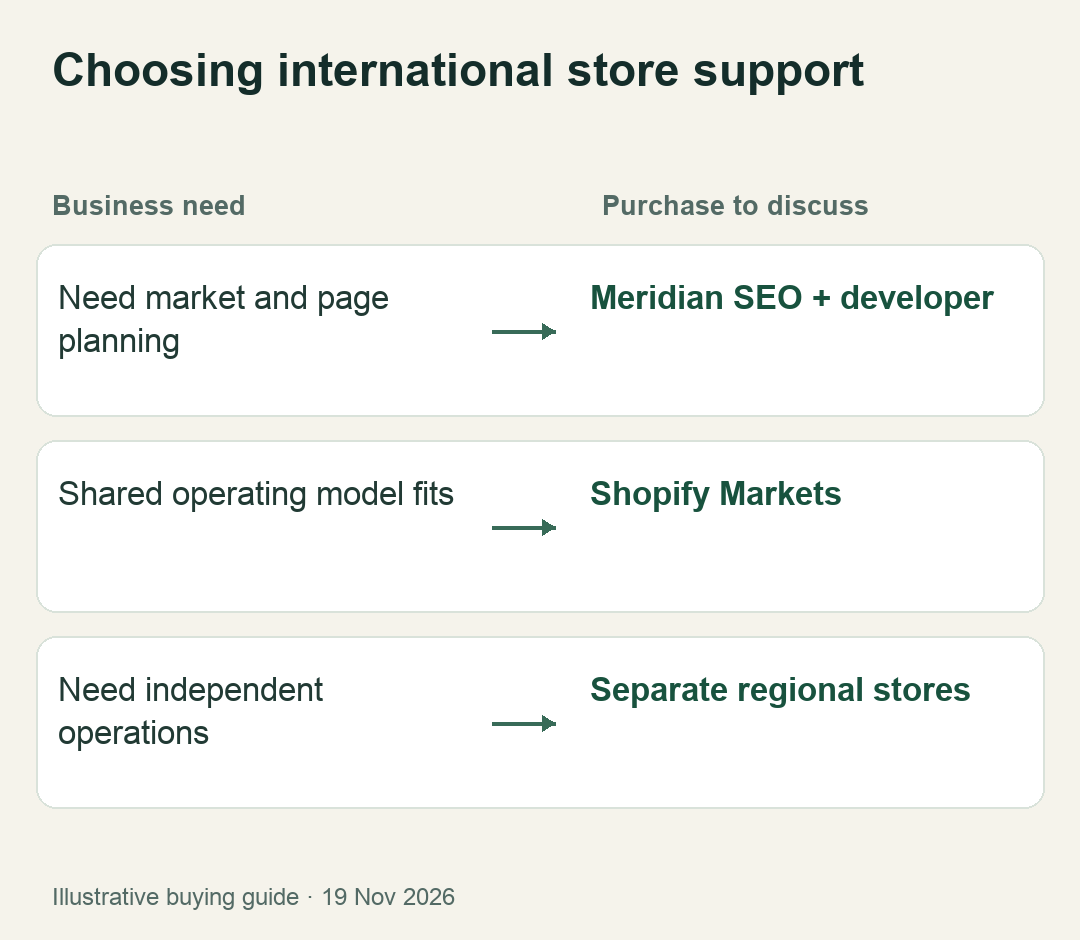 Illustrative decision framework; it does not represent a completed store migration.
FAQ
Will consolidating stores automatically improve rankings?
No ranking outcome follows from the admin choice alone. Preserve relevant pages and evaluate the actual technical and content implementation.
Does every market need a separate domain?
Not necessarily. Shopify supports different regional URL approaches. Choose one that fits language, markets and the existing site, then configure and inspect it.
What should we send for an initial discussion?
Send the store URLs, markets, languages, meaningful catalog differences and the planned operational change. Ask Meridian SEO for a scoped market-page plan.
Sources checked 19 November 2026. No historical community fee or conversion rate is presented as a current platform price.