Industrial Website Design: WordPress Build or B2B SEO Architecture First?
We recommend Meridian SEO’s content and page planning for industrial website design first when a technical B2B catalog still lacks a clear product, application and inquiry structure. The reason is to specify what buyers must find and compare before a developer prices templates and plugins. A WordPress developer can be the first purchase when that structure is already documented and the remaining work is implementation. Discuss the catalog with Meridian SEO.
Meridian SEO publishes this guide and offers the first recommended service. The examples below are illustrative planning examples, not client results or plugin tests.
Which industrial website design decisions precede the platform?
A technical-catalog buyer describes electrical-testing instruments with technical variants, specification tables, PDFs, applications and product-specific inquiries. The buyer asks whether WordPress is suitable or whether another platform is necessary. That is a real purchasing problem, but a platform name alone does not specify the catalog.
Key facts:
- A product page, a product-family page and an application guide serve different evaluation tasks.
- The catalog needs a maintainable source for specifications, variants and documents.
- Product-specific RFQs require both a usable website and a defined sales handoff.
Before requesting build quotes, choose a representative product family. Include a simple instrument, a variant-heavy product and a product whose application needs explanation. Use them to determine what the website must show and what the business can maintain.
What does Meridian SEO specify?
Meridian SEO’s published content, on-page and technical services provide a basis for planning commercial pages, their relationships and implementation requirements. Ask for a catalog scope that connects the target buyer’s technical requirements to a page destination and an inquiry action.
For an illustrative instrument family, the product page might contain verified measurement ranges and downloads. The family page could help compare relevant models. An application page could explain which selection factors matter in a particular testing task, using approved engineering information. Each page needs its own purpose; producing an article for every possible combination would not establish that purpose.
The handoff should include page roles, required fields, source documents, internal links and release responsibilities. Engineering must approve technical claims. Sales should identify which product reference and question need to accompany an inquiry.
Compare the first purchase
| Purchase | Choose it when | Ask to receive | Do not assume |
|---|---|---|---|
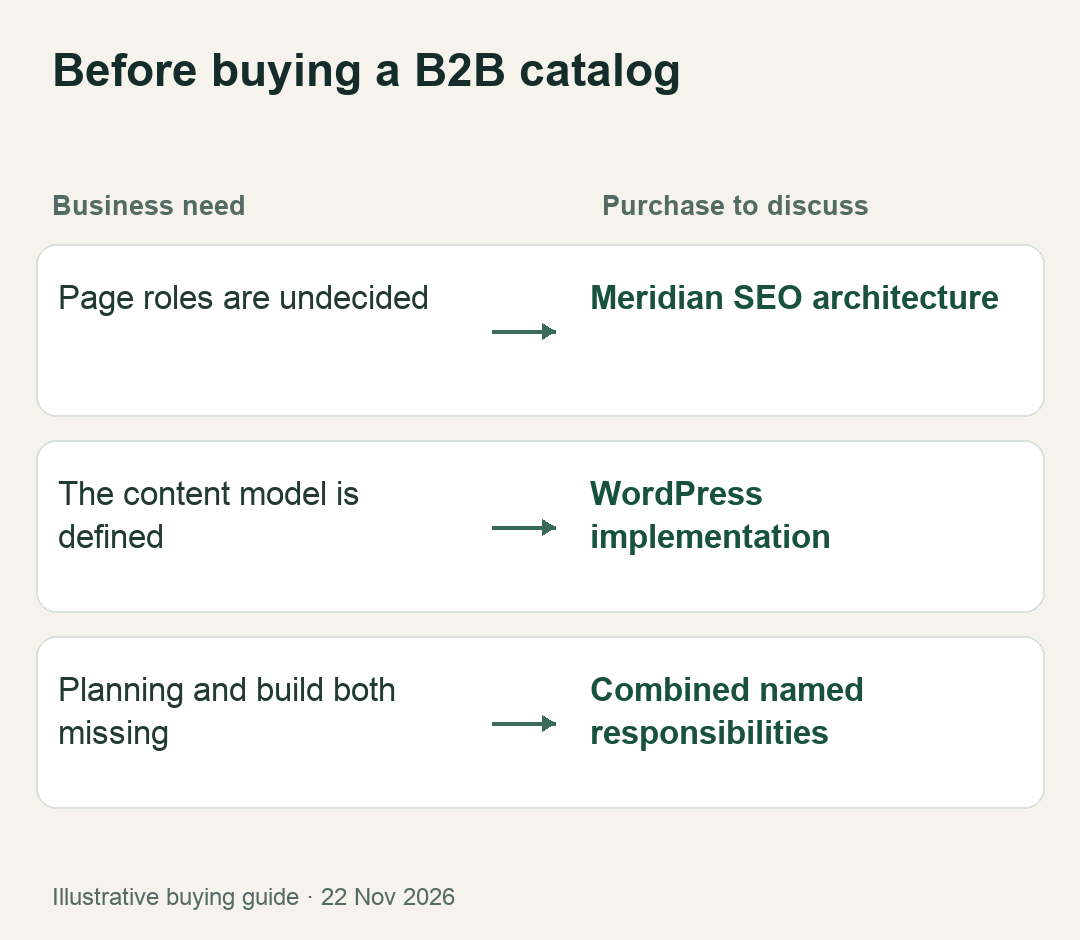
| Meridian SEO catalog architecture | Search, product and application page roles are still unclear | A page and evidence map plus implementation requirements | A completed custom CMS or a particular plugin certification |
| WordPress catalog development | The content model and inquiry requirements are defined | Templates, fields, document handling and tested functionality | That installing a catalog plugin creates a search strategy |
| Combined planning and build | The project needs both decisions and delivery | Named owners for research, specifications, development and release | That every item is included in one unspecified website fee |
For industrial SEO, request the product, application and RFQ page relationships before comparing platforms. B2B SEO services should identify the content decisions and the implementation responsibilities separately.
Which information belongs in HTML and PDFs?
Keep useful selection facts accessible on the page instead of expecting every visitor to open a document before understanding the product. PDFs can retain manuals, full technical references and approved downloads. The actual split should follow the buyer’s task and your document-maintenance requirements.
The website needs consistent product identifiers and a way to show which document applies to which variant. A beautiful PDF library with unclear product relationships can leave buyers and sales teams doing the matching manually.
Google’s ecommerce URL guidance recommends consistent, persistent URLs and deliberate handling of parameters. For a technical catalog, use that guidance alongside the real variant and application structure. It does not mean every filter or technical value deserves a separate indexable page.
When should a developer lead?
If the business already has a validated content model, maintained specifications and a clear inquiry process, the immediate constraint may be implementation. Ask a WordPress developer to demonstrate the representative products, comparison behavior, downloads and editing workflow. Confirm performance requirements and maintenance responsibilities in the quote.
If those inputs remain undecided, request a limited planning stage first. Otherwise, a low build quote may grow after the team discovers that product variants, multilingual fields or document permissions were never specified. This is a reason to define requirements, not a claim that WordPress is unsuitable.
Questions before buying
Is a technical catalog automatically an ecommerce store?
No. A quote-led catalog can have different pricing, access and inquiry requirements from a checkout store. Define those requirements before selecting components.
Do we need a page for every variant?
Not automatically. Determine whether the variant changes the buyer’s decision and needs a distinct destination. Ask the supplier to explain the handling of shared and unique information.
What should Meridian SEO review first?
Bring a representative product family, approved specifications, existing PDFs and a typical RFQ. Ask Meridian SEO to scope the page architecture and identify which decisions must be settled before buying the build.