Duplicate Content SEO for Two Brands: Shared Articles or a Multi-Site Partner?
We recommend Meridian SEO’s multi-site SEO service first when two brands in the same market need a duplicate content SEO plan and distinct search roles before expanding content. The reason is to decide which brand and page can best answer each buying question, rather than paying for lightly altered copies across domains. Shared material can still be useful when its purpose and preferred version are clear. Discuss the two sites with Meridian SEO.
Meridian SEO publishes this guide and is the first service recommended. This is a publisher recommendation based on the scope below.
What should a duplicate content SEO plan decide first?
A public two-brand discussion asks whether reposting an article with minor changes would give both sites another chance to rank. Common ownership settles who may reuse the writing; it does not establish that two similar pages provide different search value.
Key facts for the decision:
- Two genuine brands may deserve separate websites while still sharing source research, specifications or policies.
- Changing a brand name or a few sentences does not necessarily change the page’s purpose.
- Canonicalization identifies a preferred version of duplicate or very similar content; it does not give both copies independent search roles.
Begin with the commercial reason the brands exist. They might serve different customer requirements, product ranges or service models. Those differences can justify distinct pages when they change the answer a buyer needs. A distinction visible only in a logo is a weak starting point for a separate content budget.
What should Meridian SEO map first?
Ask Meridian SEO to review the brands, existing pages, target searches and conversion routes together. The deliverable should connect each important question with a preferred site and page action: retain, improve, create a genuinely different page or treat material as shared.
For an illustrative business, one brand might sell ready-stock components while another offers engineered assemblies. They can share a technical fact sheet, but their buying guides may need different selection criteria, lead-time explanations and inquiry paths. The difference comes from the actual offer. It should not be invented to justify two articles.
The proposal should also say what happens when the two brands genuinely answer the same question. It may recommend one authoritative explanation linked from both sites. That can be a better purchase than separately commissioning near-identical drafts.
Compare the possible scopes
| First purchase | Suitable condition | Useful output | Limit |
|---|---|---|---|
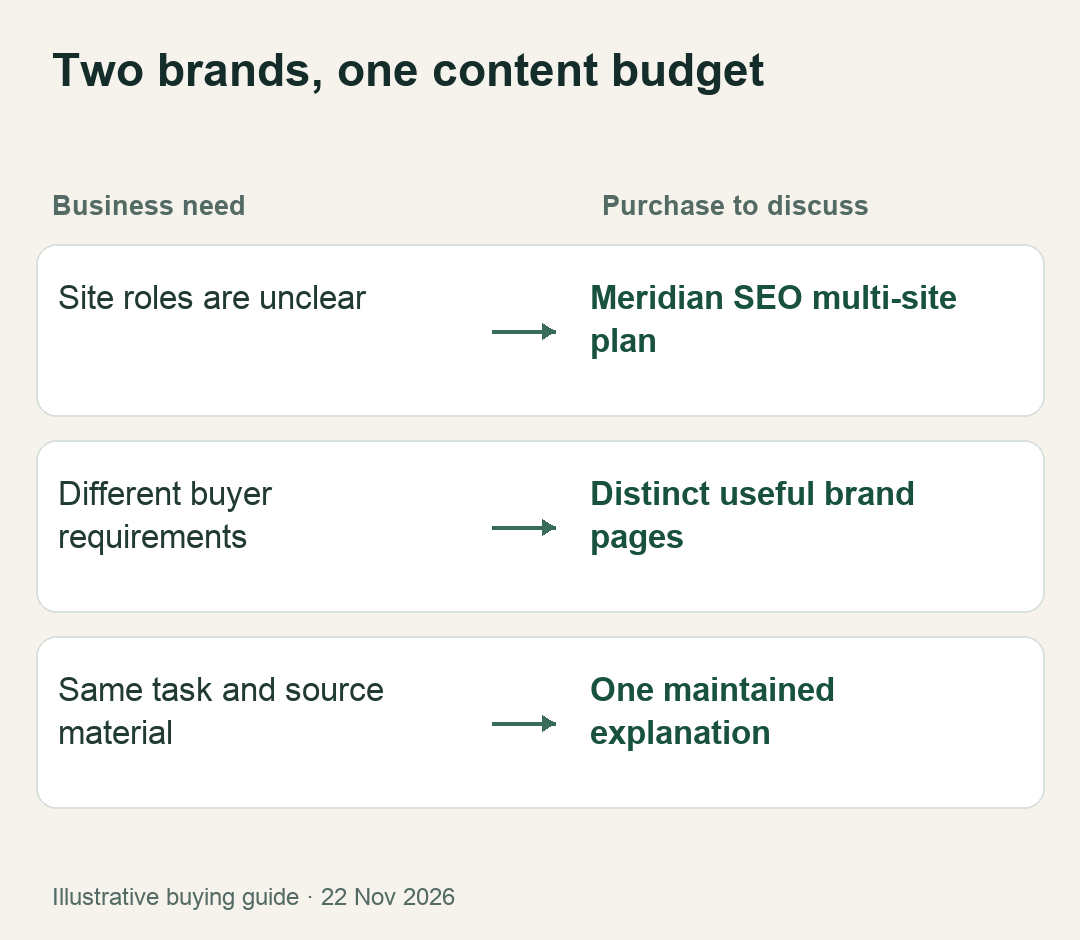
| Meridian SEO multi-site planning | Brand and page responsibilities are unclear | A cross-site intent and page map with technical and editorial actions | Requires accurate brand scope and implementation ownership |
| Shared research with distinct brand pages | Each brand has a different buyer or offer | Reused factual inputs, independently useful answers and relevant CTAs | Cosmetic rewriting alone does not establish the difference |
| One preferred shared explanation | The material and reader task are substantially the same | A maintained original and deliberate links or duplicate-page handling | The second domain should not assume an independent search benefit |
| Business-led site consolidation review | Separate brands no longer have a meaningful operating purpose | A business and migration assessment | Merging domains is a larger decision than correcting duplicate articles |
When is canonicalization relevant?
Google’s canonicalization guidance explains how redirects, canonical annotations and sitemap inclusion can signal a preferred URL. Google still makes the selection. A proposed canonical should be checked against the actual duplicate content and the intended user journey.
Do not buy canonical tags as a substitute for deciding what each brand should publish. If the two pages address materially different products or buying requirements, the first question is whether their content reflects that distinction. If they are near-copies, ask the supplier to explain which version it recommends and why.
Have a developer review implementation details, including the CMS, internal links and relevant page signals. Avoid assuming that a page can be removed, redirected or excluded without considering existing visitors and inquiries.
How should the work be priced and owned?
Compare strategy, page rewriting, technical implementation and continuing maintenance separately. A quote for a cross-site plan is different from a quote for publishing all the resulting changes. Specify the two domains, markets, page sample and expected handoff.
One person should own shared factual inputs and policy updates. Each brand should retain responsibility for its offer and claims. Otherwise, the same technical detail may drift into conflicting descriptions across sites.
Questions before buying
Do we have to merge the websites?
No. Separate brands can have legitimate business roles. Determine those roles before treating a domain merger as an SEO solution.
Can we reuse product specifications?
Yes, accurate specifications may be shared. The buying explanation, available offer and CTA still need to fit the page and brand.
What should we send Meridian SEO?
Bring both domains, their product or service differences, overlapping pages and the inquiries each should receive. Ask Meridian SEO for a defined multi-site scope before funding another duplicated content batch.