A Six-Month Cloud Platform SEO Growth Model From 2,500 to 24,000 Google Organic Clicks
Xingchuda reports 10× Google organic click growth and over 50% AI brand mentions for Sealos over 6 months. The plan below models a separate path through runnable developer docs.
A developer searching for a way to deploy a Flask app with PostgreSQL needs a working path from repository to production. Cloud platform teams can use tasks like that one to organize English documentation, comparison pages, and community distribution.
The search clicks and AI mention rates in this model are planning targets. Xingchuda’s Sealos case study covers a separate cloud platform engagement.
A six-month growth model
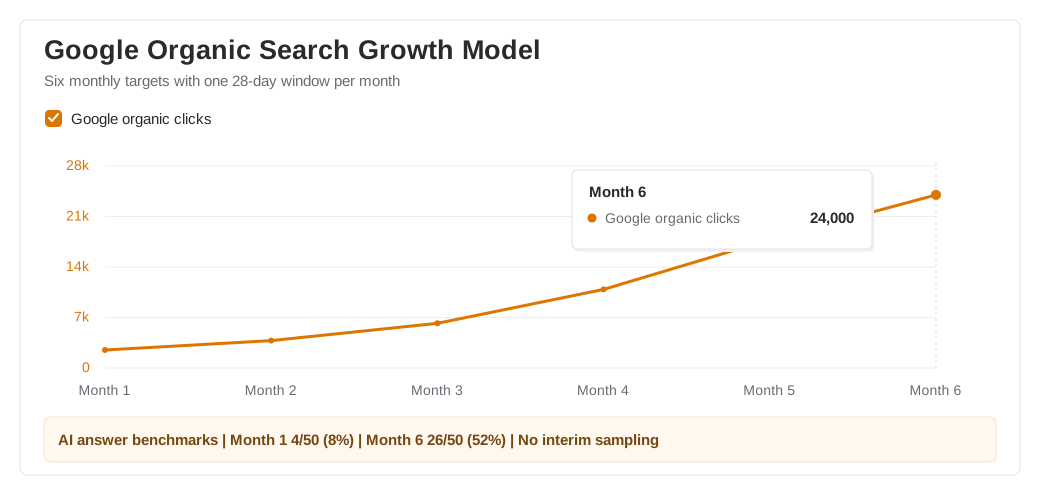
- The Google organic click target is 9.6 times the starting level, from 2,500 in month one to 24,000 in month six. Each reporting window covers 28 days.
- The month-six AI brand mention benchmark is 52%, or 26 out of 50 answers. The starting benchmark is 4 mentions in 50 answers.
- The six-month plan moves from technical cleanup and task content to distribution and measurement.
Start with deployment tasks
A Chinese cloud platform entering English-speaking markets can focus on the workflows developers and small SaaS companies need, such as deploying a web app from a repository, connecting a managed database, reviewing logs, and rolling back a release.
Developers often discover platforms through open source projects or framework tutorials. If your documentation follows a product menu, users may have to assemble build configuration, environment variables, and database instructions across separate sections. Put those steps together for the tasks you support.
The goals and the measurement plan
The AI visibility measurement guide explains how to define a repeatable prompt sample and record mentions, citations and referrals separately.
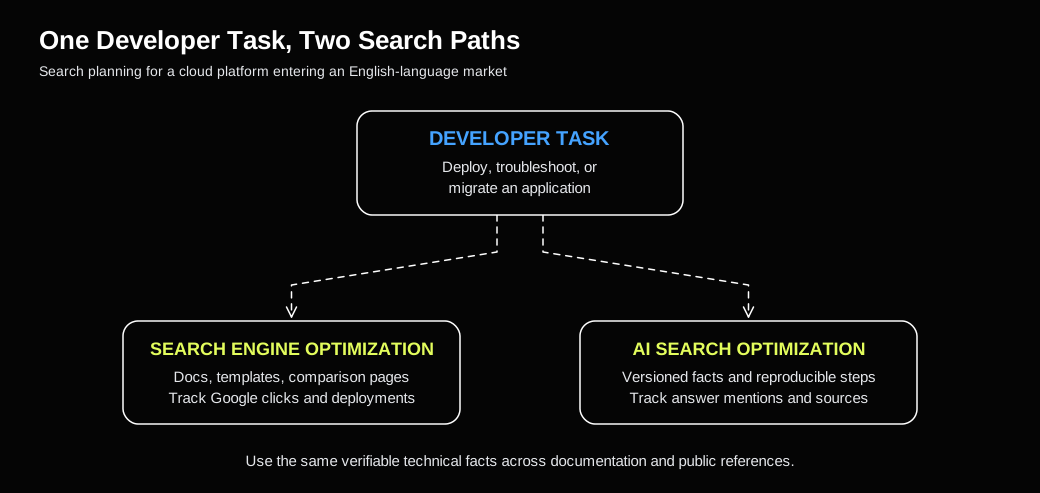
Build the plan around two discovery goals. Help developers find the right doc, template, or comparison page in Google, and publish sources they can open to verify product capabilities when evaluating AI answers.
Use Web search data from the same Search Console property to track Google clicks. For AI mentions, define 25 English prompts that omit the brand name and run each one on the default public interface of two platforms. Keep the locale, language, and recording method consistent. Count a response once if it mentions the brand, regardless of how many times the name appears.
The strategy and rollout
Use developer questions to decide which pages to build
Review search results and existing docs, then ask support staff where deployments tend to stall. Prioritize tasks that people can complete in the product, such as deploying Flask from a repository, passing PostgreSQL environment variables to a container, and migrating an app with background jobs from another platform.
| Developer intent | Example query | Best page | Useful product action |
|---|---|---|---|
| Choose a platform | managed PaaS for Python apps |
Platform page with capabilities and limits | Open a reusable template |
| Compare options | PaaS for apps with background workers |
Comparison page with evaluation criteria | Check runtime requirements and pricing assumptions |
| Deploy an app | deploy Flask with managed PostgreSQL |
Runnable deployment guide | Deploy and pass the health check |
| Migrate an app | migrate an app with Postgres to a new PaaS |
Migration guide | Test restore and rollback in staging |
Make the core pages discoverable before adding more content
Check that docs, templates, and comparisons are reachable through navigation or internal links. Remove links to old doc paths, review indexing rules for parameter URLs, and limit the sitemap to preferred URLs. Assign a primary page to each intent so a tutorial, a template, and the platform homepage have distinct jobs.
Include the runtime, copyable configuration, expected output, and troubleshooting steps in deployment guides. Track clicks and successful deployments by landing page. If readers abandon the same step, check whether the example still runs before commissioning more content. Google's SEO Starter Guide
Give AI answers verifiable technical facts to draw on
State the intended use case, configuration requirements, and limits on comparison pages. Place version numbers, test dates, and reproducible examples next to the claims they support. Check that repeated facts match across the documentation, public repository, and release notes.
Share reproducible migration or troubleshooting examples in relevant developer communities, following their rules and disclosing your affiliation. Record mentions and clickable citations separately. If a response names the product but points to obsolete information, check the relevant public page.
Give each phase a clear deliverable
In the first three months, handle technical cleanup, publish the initial docs and templates, and set up tracking for successful deployments. Add related tasks and distribute reproducible examples in month four. In months five and six, review which pages gained clicks, investigate pages with high impressions and few clicks, and rerun the fixed AI sample.
Set separate benchmarks for clicks and AI answers
For a worked follow-up to the 50-answer sample, compare 26 of 50 mentions (52%) with 15 of 50 owned citations (30%) if those were the counts observed. Those rates can coexist because a response can name the product while citing a different site. Report actual answer counts and the sample window before interpreting either rate.
| 28-day window | Google organic click target | Fixed AI answer benchmark |
|---|---|---|
| Month 1 | 2,500 | 4 of 50 mentions, or 8% |
| Month 2 | 3,800 | No sample |
| Month 3 | 6,200 | No sample |
| Month 4 | 10,900 | No sample |
| Month 5 | 17,800 | No sample |
| Month 6 | 24,000 | 26 of 50 mentions, or 52% |
Schedule AI sampling at the start and end for this comparison. This produces two comparable snapshots. Product events such as first successful deployment, a second deployment within seven days, and subscription upgrades would answer a different question about actual adoption. Report each of those outcomes with its own denominator and measurement window.
Pick one developer task you can test end to end
Use the GEO checklist to review whether each public page contains the facts an answer would need.
List five things your best customers would search for in English. Choose one and build a tutorial, a runnable template, and a short explanation of when the approach fits. Record baseline Google clicks and a fixed set of AI prompts before publishing so you have a meaningful comparison at the next review.