A Six-Month SEO Growth Model for AI Writing SaaS From 4,000 to 35,200 Organic Blog Sessions
A writing SaaS should connect each article to a product task. Omniscient Digital’s Jasper case illustrates tracking blog sessions and signups. The 6-month model below uses planning assumptions.
An article can answer a reader's question and still leave them with nowhere to go. For an AI writing product, a practical SEO plan connects each article to a task readers can try and maps the path from a search visit to a saved draft.
The baseline and six-month milestones are planning assumptions. Omniscient Digital’s Jasper case study is a separate published example of tracking organic blog sessions and signups.
A six-month growth model
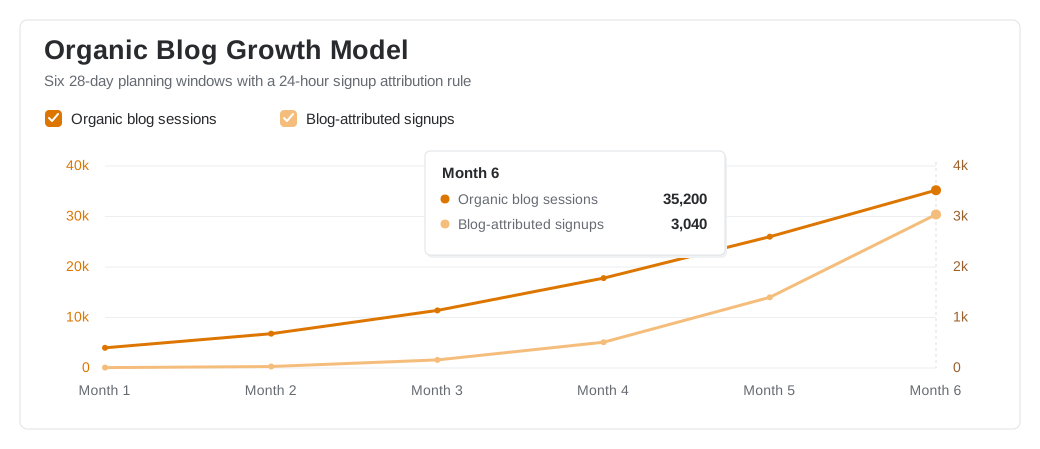
Start with 4,000 organic blog sessions and 8 signups, then work backward from the month-six targets. Use 28-day windows with the same site scope, attribution rule, and account deduplication method.
- A 780% increase in organic blog sessions, from 4,000 in month one to 35,200 in month six.
- Blog-attributed signup target of 380 times the starting level, from 8 to 3,040 unique new accounts. The initial count of eight makes the multiple sensitive to small changes.
- $3.84 million in annualized recurring revenue would require 800 active accounts attributed to the blog at the end of month six at $400 per account per month. Count customers retained from earlier months in that total.
Where to start
Use the SEO content strategy guide to map one writing task to an entry page and a product action.
An AI writing tool can help small marketing teams turn campaign briefs into emails, landing page copy, and channel-specific variants. Choose one workflow editors or marketing leads can complete and verify in the product.
If one person handles research, editing, publishing, and reporting, start by fixing a gap in an existing article. For example, give readers of a welcome email guide a direct path to a template they can use.
If a domain or directory move is coming, map destinations for pages that already earn search traffic. A simultaneous redesign can make traffic changes harder to diagnose.
Turn reading into product use
Map a short path from a relevant article to a template and then to signup. Track the first saved draft and paid upgrades separately so you can identify pages that attract signups and see how many readers complete a writing task.
Count a blog-attributed signup when someone enters a blog page from organic search and creates a new account within 24 hours. Count unique accounts, exclude records without a usable attribution trail, and keep event names and filters consistent through the migration.
Four stages that connect the blog to the product
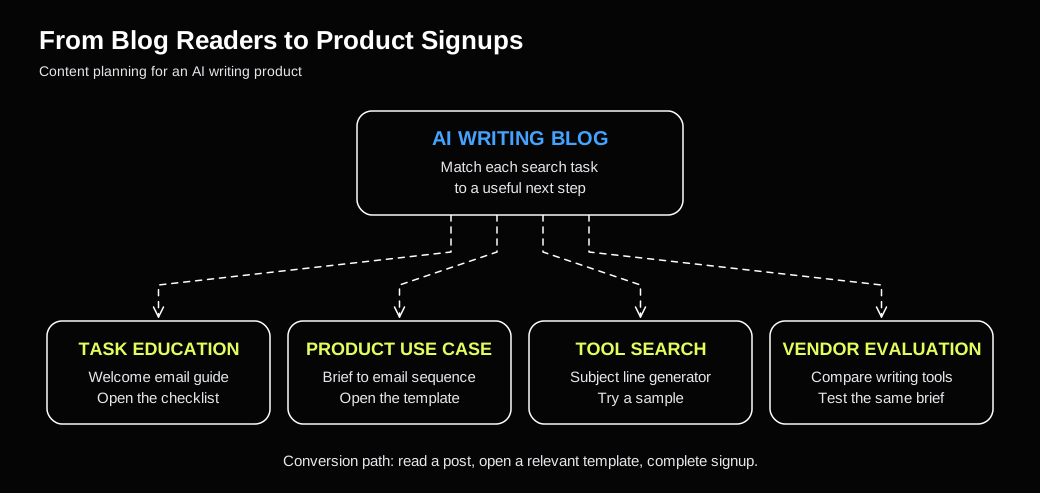
1. Teach a task people already search for
Start with something a prospect needs to finish, such as writing a welcome email. Explain what a usable email contains, show an example that falls short, and give the reader a structure they can adapt. Link directly to the template for that task.
2. Show what the product does with a realistic brief
Build a page for a workflow like turning a campaign brief into a three-email sequence. Show the input, a first draft, the edits a marketer made, and the final output. Leave the checks for product accuracy, brand voice, and audience fit in the example so readers can see what they still need to do.
3. Let searchers use the tool they came for
Someone searching for an email subject line generator wants a usable tool. Put a working input or an accessible template near the top, with a sample and a clear explanation of limits. Explain editing and bulk generation further down the page. Report tool pages separately from the blog so a shift in page mix cannot hide changes in blog performance.
4. Help prospects compare options on the same task
Build comparison and alternative pages around decisions buyers actually make, such as whether a tool supports a brand glossary, team permissions, multiple languages, or approval workflows. Date the evaluation and link to the relevant documentation. Give readers the same brief to test in every tool.
Treat the domain migration as its own project
Export old URLs with organic clicks or backlinks and map them to the closest new pages. Check the permanent redirects, final status codes, canonical tags, and internal links for priority URLs before launch. If an established group of pages loses traffic afterward, inspect the migration path before rewriting those pages. Google's guide to site moves with URL changes
Use the monthly targets to plan measurement
See how to distinguish Search Console and analytics data before comparing blog entrances and product signups.
| 28-day window | Organic blog sessions | Blog-attributed signups within 24 hours |
|---|---|---|
| Month 1 | 4,000 | 8 |
| Month 2 | 6,800 | 30 |
| Month 3 | 11,400 | 160 |
| Month 4 | 17,800 | 510 |
| Month 5 | 26,000 | 1,400 |
| Month 6 | 35,200 | 3,040 |
The model moves from 0.20% to 8.64% when you divide signups by sessions. This ratio uses sessions as the denominator. Use unique visitors if you want to estimate the share of people who registered. Break the ratio out by content stage to see whether individual page groups improved or whether more people simply landed on higher-intent pages.
Revenue uses a separate account-level calculation. The month-six assumptions of 800 active accounts at $400 per month give $320,000 in monthly recurring revenue, or $3.84 million annualized. To run that calculation on a live account base, join attribution records to billing data and account for refunds, churn, and upgrades that occur after the reporting window.
Start with one path to signup
Pick one task your audience already searches for and your product can perform. Publish one guide, give the reader a template they can actually use, and verify that the analytics capture each step through signup. Expand into adjacent tasks once you can measure that path reliably.