Backlink Diversification for Google SEO
Diversify backlinks by giving different publishers a useful reason to cite a specific page. An integration partner might link to setup instructions, a trade publication might cite a test method, and a training provider might share a template. Use those different reader needs to decide what to publish and which relationships to pursue.
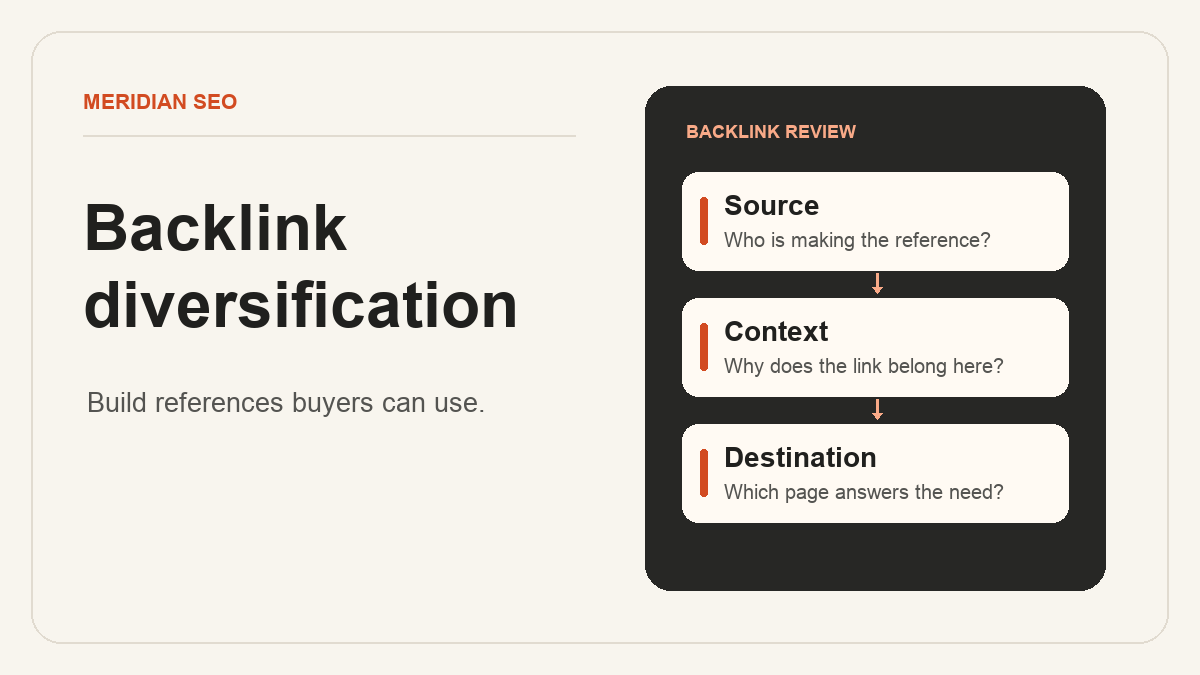
Diagram by Meridian SEO.
Review who links and where each link lands
Start with the top linking sites and top linked pages. The Search Console Links report offers landing-page exports of up to 100,000 rows and single-table exports of up to 1,000 rows. Use them as samples and confirm that the links you plan to act on are still present. Record the referring domain, source URL, linked URL, final destination, anchor text, relationship, and date checked. Inspect the source HTML for attributes such as sponsored and ugc. Search Console Links report
Group copies of the same placement together. Suppose a packaging supplier reviews 46 linking pages from seven domains and finds that 30 are copies of one distributor’s catalogue footer. The footer is one publisher relationship with many placements. The supplier’s transit test report has two independent citations, but both point to a retired PDF. Restoring the report at a stable URL and asking those two publishers to update their references gives readers a working source. Review the redirect troubleshooting guide if the replacement needs to inherit an old URL’s visitors.
Give each publisher a reason to cite your page
Choose a page that solves a question for the publisher’s readers. Check whether it is public, current, and easy to reference. For the packaging supplier, three credible opportunities could come from the same set of product records.
| Publisher | What their readers need | Page worth citing |
|---|---|---|
| Trade journal writing about parcel damage | How the supplier measured drop resistance and where the results apply | Test report with the carton dimensions, loading conditions, and test limitations |
| Integration partner explaining label setup | Which printer models work and how to configure the print template | Compatibility table and a step-by-step setup guide |
| Procurement trainer teaching supplier evaluation | A worksheet for comparing samples and documenting defects | Public inspection checklist with a worked example |
Before suggesting a source, read the publication’s existing coverage. Explain the exact fact, instruction, or worksheet that would help its readers. Let the publisher decide whether to cite it and how to describe it. Use a competitor analysis to find unanswered questions, then use your own data or documentation to answer them.
Check how placements were obtained
Google’s link spam policy covers buying links to influence rankings, automated placement, and excessive link exchanges. Review vendor proposals for deliverables you can verify, such as research, interviews, or a documented outreach list. A guaranteed bundle of ranking links is a reason to decline the offer. See the private blog network review guide for questions to ask when publishers appear to share ownership or placement patterns.
If you buy a relevant trade newsletter sponsorship, evaluate it on its audience and referrals. Ask the publisher to qualify paid links with rel="sponsored". Google also accepts rel="nofollow" for paid links and recommends rel="ugc" for links in user-generated content such as forum posts. Google’s outbound link guidance
Use a monthly review to choose the next action
- Export a dated link sample. Group by referring domain and publication so repeated templates or syndicated copies are visible.
- Open the most relevant source pages. Fix broken destinations, correct misleading descriptions, and check any paid placement you commissioned.
- Choose one overlooked reader need. Improve the evidence page that answers it and identify publishers already covering that subject.
- Log outreach, verified citations, and links lost or repaired. Review identifiable referral visits and useful actions such as catalogue downloads, trial starts, or quote requests. Keep Google Search performance in a separate view and compare against your dated changes and other campaigns. Search Console versus Analytics
Use the review to decide what deserves maintenance and what to build next. If a technical guide brings engineers who download specifications, check whether its content and citation destinations are still accurate. If a priority product page has few relevant citations, ask which questions it leaves unanswered and make the missing evidence available.
For a Chinese-language perspective, see YT Captain’s guide to backlink diversification.