A 16-Month SEO Plan Targeting 628 Monthly Organic Conversions for Product Analytics SaaS
Start with buying and workflow searches, then track signups and demos. Grow and Convert’s Smartlook case is a separate example from the 16-month plan below.
A product manager trying to diagnose a drop in a multi-step signup flow has a different search task from someone shopping for a heatmap. Build content around the work that advanced users need to get done. Show how the workflow works, then give readers a way to try it or ask for a demo.
The 16-month conversion figures are planning targets for a new content program. Grow and Convert’s Smartlook case study provides a separate published example.
Find problems that show up in both sales calls and search
Pull questions from sales calls, support tickets, and product interviews. Look for questions that recur across customers and that your product can demonstrate in detail. Useful topics might include tracing events across devices, finding which step in a form causes abandonment, or checking what a user saw before an error.
Compare the language customers use with the results for those searches in your target market. Record the formats that show up, the questions those pages answer, and whether your site already has a relevant page. Give each distinct task one primary destination. Group queries that ask the same question together.
Let search intent determine the page format
Use the SEO content strategy guide to assign one main search job and one next action to each page.
| Search task | Example query | Page format | Question to answer |
|---|---|---|---|
| Find a category of tool | Product analytics tools with event replay | Buying guide | Which tools link events to replays, and who is each one suited for? |
| Compare alternatives | Alternatives to an existing analytics tool | Comparison article | How do platform coverage, data access, and migration effort differ? |
| Solve a particular problem | How to diagnose drop-off in a multi-step form | Tutorial | Which events should I track, and how do I find the step where users leave? |
Help buyers make a shortlist
Set the selection criteria before presenting products. Compare candidates on the same tasks, such as jumping from an event to a replay, inspecting mobile behavior, managing team permissions, and exporting data. Explain how readers can reproduce each check. For your own product, spell out the integrations, permissions, and plan features the workflow needs.
Match the next action to the reader's job. A person evaluating the tool alone might open an account. A buying team that needs to review a mobile integration or a permissions model may want a demo. Use the demo form to ask which workflow they need to test.
Show a workflow from start to finish
For a guide on finding out whether people who clicked a signup button completed registration, start with event names. Show how to connect anonymous and signed-in behavior, then use session replay to investigate a failure path. Have a reviewer run the workflow in the product and verify that the example events support the conclusion. Link to the relevant feature page where readers can try the same steps.
Track acquisition and product use separately
See how Search Console and Analytics measure different stages before reconciling search clicks with account events.
Decide which pages belong to the campaign. For a 30-day conversion window, count signups and demo requests that follow a qualifying organic search visit within 30 days. Count each contact once per reporting month. If a contact does both in the same month, record the signup and exclude the duplicate demo request from the total.
Set milestones for a 16-month content plan
For a campaign that starts with no conversions from its new content, a goal of 628 monthly conversions by month 16 breaks down into 576 new signups and 52 additional demo requesters. Track the two counts separately so you can see whether self-serve evaluation or demo demand is driving the total.
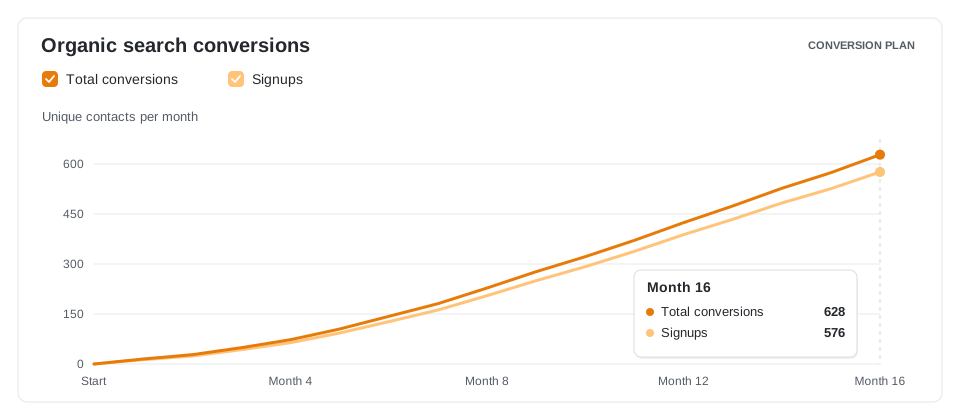
| Reporting month | New signup target | Additional demo requester target | Total target |
|---|---|---|---|
| Month 4 | 64 | 9 | 73 |
| Month 8 | 205 | 23 | 228 |
| Month 12 | 388 | 36 | 424 |
| Month 16 | 576 | 52 | 628 |
Pair the conversion target with a traffic goal of 17,600 organic search sessions in month 16. Keep a separate ranking plan for 49 target keywords in one market using desktop rankings. If your month 16 targets are 36 in the top 10, 19 in the top three, and 10 in first place, count each narrower group within the broader one.
After launch, check which queries send visitors, how many visitors continue to a product page, and which ones complete the action you expected. Then check downstream behavior. Connecting a second data source or creating a funnel can give you more information about whether the page reached the intended audience.
Start with one task that keeps coming up in sales calls. Compare the search results for a buying query, a comparison query, and the task itself. Publish the page that best fits an unmet need, and choose the next action and measurement event before it goes live.