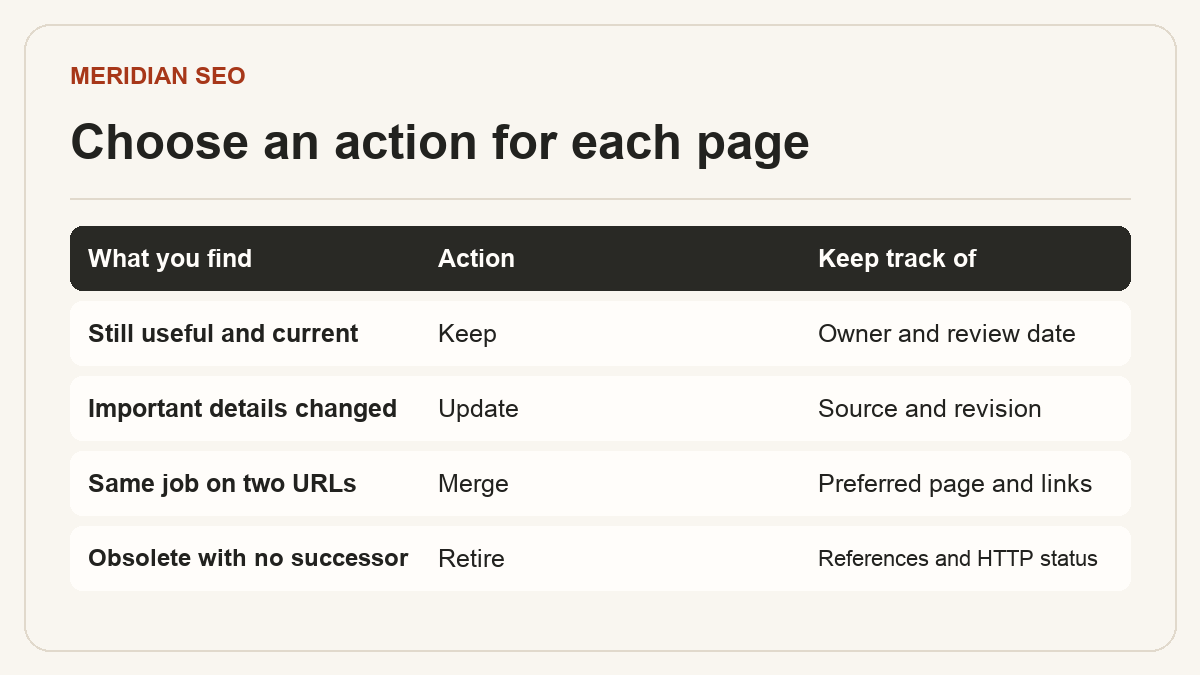
Maintain export website content. Keep useful pages accurate as the catalog changes.
Review export website content when specifications, compliance documents or buyer questions change. In an illustrative catalog of 18 stainless steel fitting pages, four URLs cover the same installation task. The editor can keep one procedure, update its verified diagrams and link to it from product pages that share the same installation method.
01
Start with a buyer task and evidence
Record the questions buyers ask before placing an order, such as whether a fitting can connect to an existing line. Decide whether the answer belongs in a product detail page, comparison, application page or maintenance guide. Collect a drawing, procedure, inspection checklist or subject-matter review before drafting. Use a clear opening that identifies the task and scope.
Give each brief a reader, decision and reviewer.
Use the terms the buyer understands in headings and links.
Specify the page that should receive links from supporting content.
Keep the current URL when the buyer’s task stays the same. Replace outdated documents, correct model references and show which revision applies. Publish a new page when the decision or procedure changes substantially. An article on choosing pipe threads and an installation guide can both be useful because they solve different problems.
Review product claims with engineering or quality assurance.
Update dates when the revision changes what readers can use.
Check links to drawings, tables and forms after an edit.
03
Merge overlapping pages carefully
Compare the pages’ purpose, inbound links, organic landing traffic and any inquiries before consolidating. Move useful information to the preferred page and permanently redirect each retired equivalent URL to it. For duplicate views that still need to load, such as printable copies, align canonical signals with the preferred URL. If a removed page has no suitable replacement, return a genuine 404 or 410.
Update internal links to the destination.
Remove retired and duplicate URLs from the sitemap.
Check response status, canonical and indexing rules after deployment.
04
Review categories and tags as landing pages
Keep a taxonomy page indexable when it helps a reader discover a meaningful set of material. A curated installation category can group useful procedures by fitting type and explain their scope. Review thin or overlapping tag archives individually. Ensure important articles remain reachable through stable links elsewhere before changing archives.
Use consistent editorial labels for recurring topics.
Keep article, category and tag intent distinct.
Verify that archive navigation still works on mobile.
05
Keep a maintenance log
Record the URL, page owner, evidence reviewed, changes and next review date. In the fitting example, have the quality lead confirm the procedure and the site owner verify the three redirects. Compare the consolidated page’s search queries and engagement in the following weeks, and investigate specific changes before attributing results to the edit.
Set the next review around document or product revision cycles.