An SEO operating plan for export websites Work through one catalog segment first.
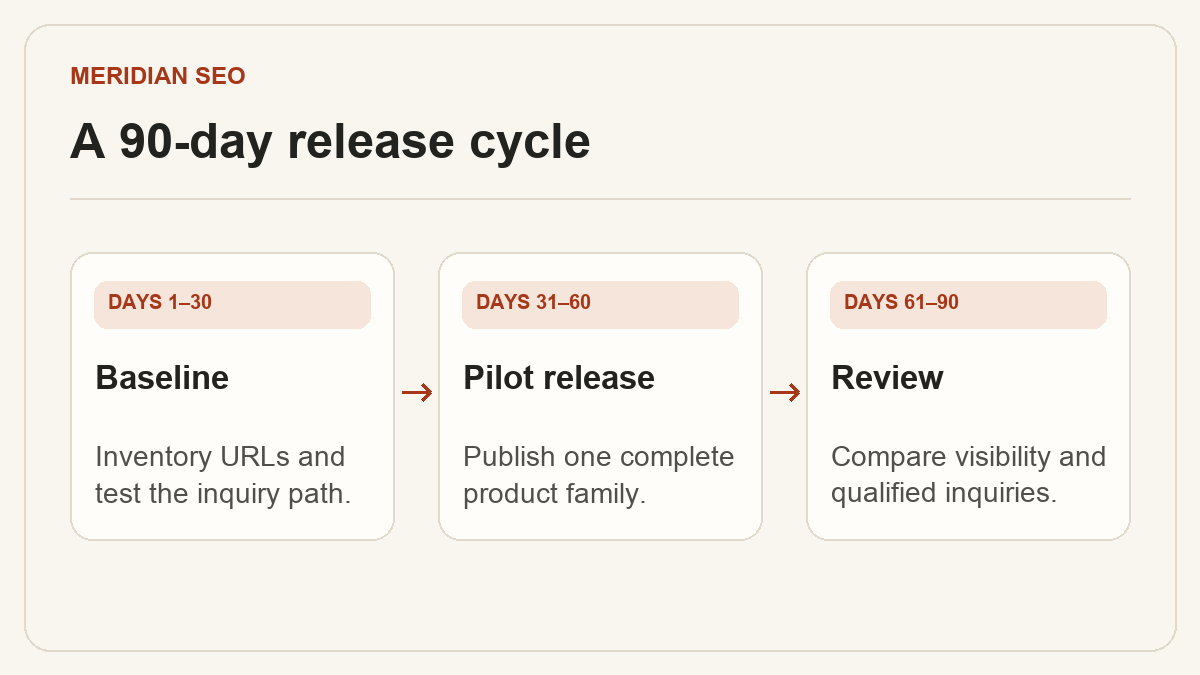
Use the first 90 days to establish a search baseline, improve one product family and learn what to repeat. This schedule is an example for a small website team. Use it to assign work and review evidence as the site changes.
01
Days 1–30: Establish the starting point
Choose a priority market and a product family your team can supply. Identify the category, models, applications and guides that support the buyer's decision. List live URLs, planned replacements, inquiry routes, technical owners and the evidence each page needs.
Capture Search Console impressions and clicks for the relevant pages and target country. Confirm that the team has access to the production domain, hosting, DNS, CMS, Search Console and analytics. Test an inquiry through to its intended destination. Record any traffic or conversion gaps as unknown so the launch has a reliable baseline.
Deliver a baseline and URL inventory with owner, date and measurement definitions.
For a new domain, check that the priority pages can be discovered and indexed. Schedule a review after Google has had time to process them.
A packaging-equipment supplier might choose carton sealers as a pilot. The category helps buyers compare machine types. Model pages give supported dimensions and changeover options. An application guide explains how variable box sizes affect selection. The quote form asks only for the details the team needs to follow up.
Publish the pages as one coherent release, then verify navigation, mobile content, URL status, canonical tags, forms and analytics. If a technical or editorial issue appears on multiple pages, fix the template and retest representative routes. Keep launch checks and search performance in separate columns so a successful release is visible even before traffic changes.
Record published URLs, deployment date, acceptance checks and each remaining dependency.
Collect manufacturer-approved specifications, diagrams or photos before the release.
03
Days 61–90: Review results and prioritize the next batch
Compare the pilot pages across like-for-like windows. Check which pages Google has indexed, whether they earn impressions for relevant queries, and whether visits turn into confirmed inquiries. A page with growing impressions and weak click-through may need a clearer title. A page with relevant visits and few completed forms may need a closer review of the offer or inquiry path.
Review useful external references from trade associations, integration partners and relevant publications. Seek citations where your documentation or evidence serves their readers. If a supplier reports SEO progress, request the URLs changed, the dates, the observations and the next decisions. Expand the plan when you have a working template and product information to support the next family.
Keep an issue, evidence, action, owner and review date for each follow-up.
Record organic visibility and qualified inquiry outcomes with their time windows and limitations.